
The short answer
Choose a side entry agitator for large, wide storage tanks where the job is bulk circulation, blending, or keeping solids and sludge off the floor, and where the roof cannot easily carry a drive. Choose a top entry agitator for tall tanks, process vessels and reactors, viscous products, and duties that need the impeller in the middle of the liquid.
How each one works
A side entry mixer enters through a flanged nozzle in the lower shell. Its impeller pumps a jet across the tank floor. The jet sweeps the floor, rises at the far wall and returns, so the whole tank turns over. The motor, gearbox, bearings and seal stay outside the tank at ground level.
A top entry agitator hangs from the roof or a beam across the top of the tank. A long shaft carries one or more impellers down into the liquid. It can be placed at the centre or off-centre, and with baffles it can mix intensely, but the roof or a bridge has to carry its weight and its loads.
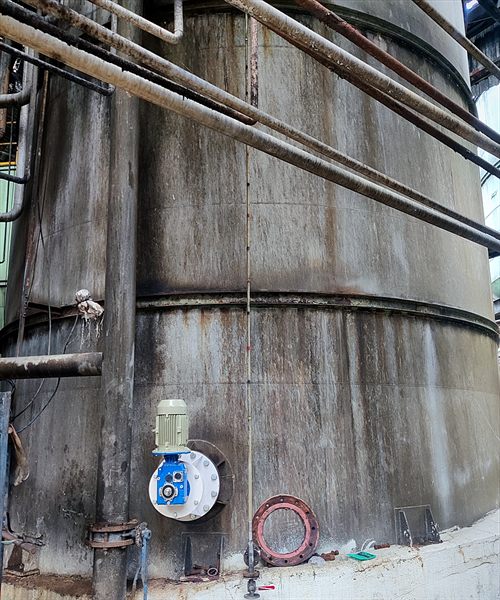
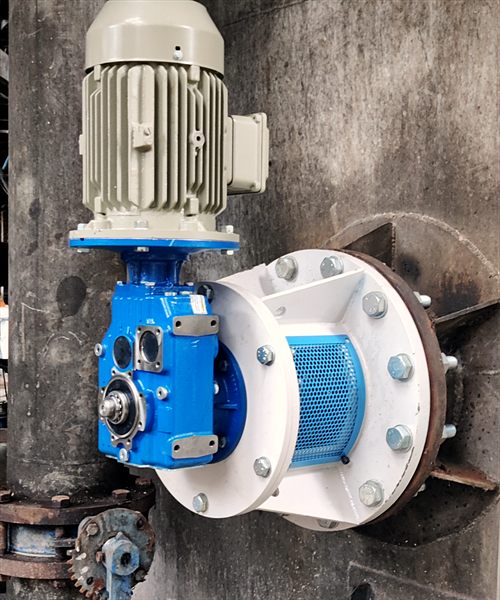
Side by side
| Side entry agitator | Top entry agitator | |
|---|---|---|
| Best tank shape | Wide, low tanks (diameter ≥ liquid height) | Tall tanks and process vessels |
| Tank size | Large storage tanks | Small to large |
| Roof or structure | No load on the roof | Roof bridge or support beam |
| Shaft | Short and overhung | Long, may need a steady bearing |
| Impeller position | Near the floor, close to the wall | Anywhere in the liquid |
| Shaft seal | Below liquid level | Above liquid level in most designs |
| Maintenance access | From the ground | From the roof or a platform |
| Viscosity | Low to moderate | Low to high |
| Typical uses | Crude and product storage, stock chests, digesters, large slurry tanks | Reactors, process tanks, high-viscosity mixing |
When a side entry agitator is the better choice
- The tank is wide compared with its liquid height
- The roof is floating, light or not designed to carry an agitator
- The job is circulation, blending, temperature equalisation or keeping solids off the floor
- You want the drive, bearings and seal reachable without roof access
- One tank needs several units, which can be grouped on one part of the shell
When a top entry agitator is the better choice
- The tank is tall, or the liquid is deep compared with the diameter
- The product is viscous, or the process needs high shear or intense mixing
- The process needs the impeller in the middle of the liquid, as in reactors and dissolving tanks
- You prefer a seal that works above the liquid level
What about bottom entry agitators?
A bottom entry agitator comes up through the tank bottom. It leaves the top of the tank free and can mix down to a very low level, which suits some hygienic and pharmaceutical vessels and tanks with a crowded top. Like a side entry agitator, its seal works below the liquid, and the space under the tank has to allow for the drive and for maintenance.
Cost: look at the whole installation
The price of the agitator is only part of the cost. On a large tank, a top entry agitator may need a roof bridge, a support structure and a long shaft, and maintenance from the roof. A side entry agitator needs a nozzle in the lower shell, and its seal works under the full liquid head, so seal choice and spares matter more. FMT seals come with a shut-off device, so the seal can be changed without draining the tank.